

Automation has become a business imperative in this decade. Companies across the globe are racing to put as much of their operations as possible on autopilot, get the most out of data to predict outcomes, eliminate errors while reducing work hours, and ultimately deliver the best possible experience for their customers.
It’s obvious that BPA, RPA, and AI-driven hyperautomation tools are more than just buzzwords, as competitive edge and market positioning now depend on digital transformation. This is especially true in industries like finance, healthcare, manufacturing, and retail.
However, investments come with both promises and pitfalls. Some companies manage to achieve tangible results and ROI within months, while others struggle with skill gaps and legacy systems that stall progress.
This extensive article dives deeply into the business process automation landscape; we have compiled insightful stats and facts about adoption across industries, challenges, and future developments. Read on to stay ahead in the automation game!
Business Process Automation (BPA) Adoption Trends
1. Nearly six in ten companies have introduced some level of process automation, with adoption even higher among large enterprises (84%).
Source: The CFO Survey by Duke University’s Fuqua School of Business
As for the key reasons for adopting automation, businesses pointed to improving product quality (58%), higher productivity (49%), lowering labor costs (47%), while about one third said the goal was substituting human labor. 37% of all surveyed firms and 55% of large ones reported already using artificial intelligence as part of their automation initiatives.
2. By 2026, about 30 percent of enterprises are expected to automate over half of their network operations.
Source: Gartner
Leaders overseeing infrastructure and IT functions in large organizations are turning to AI-driven analytics and generative AI to handle vast data volumes, improve decision-making, and streamline operational processes.
3. Around 90% of large enterprises now see hyperautomation as a key strategic priority.
Source: Gartner
Hyperautomation brings together multiple advanced technologies, including artificial intelligence, machine learning (ML), robotic process automation (RPA), the Internet of Things (IoT), and business process mining, to automate complex workflows from start to finish.
Its main goals include eliminating manual tasks, human error, and boosting overall efficiency. Platforms like n8n, Automation Anywhere and UiPath enable organizations to create customized automation workflows by connecting different systems and data sources.
4. As much as 87% of enterprise developers now rely on low-code platforms for areas such as customer relationship management, marketing and sales, human resources, data analytics, or supply chain management.
Source: Forrester
Because low-code tools can automate complex business workflows and easily integrate with existing IT systems, platforms like Zapier, Appian, Kissflow, Cflow, and Pipefy have become widely adopted. These tools can accelerate software development by as much as tenfold.
5. Up to 30% of jobs could be automated by the 2030s.
Source: McKinsey & Company, PwC
Generative AI is accelerating job automation. While it improves workflows for professionals in STEM, creative, business, and legal fields, automation is expected to reduce demand in roles such as office support and customer service.
6. The industries leading the adoption of business process automation include financial services, manufacturing, healthcare, and retail & eCommerce.
Source: VegamAI
In manufacturing, automation has already eliminated billions of working hours. Within financial services, about 25 percent of banking activities can now be automated. In healthcare, adoption is growing rapidly, with key applications in patient scheduling, claims processing, and medication management.
7. In the United States, 89 percent of employees said they felt more satisfied with their jobs after automation was introduced.
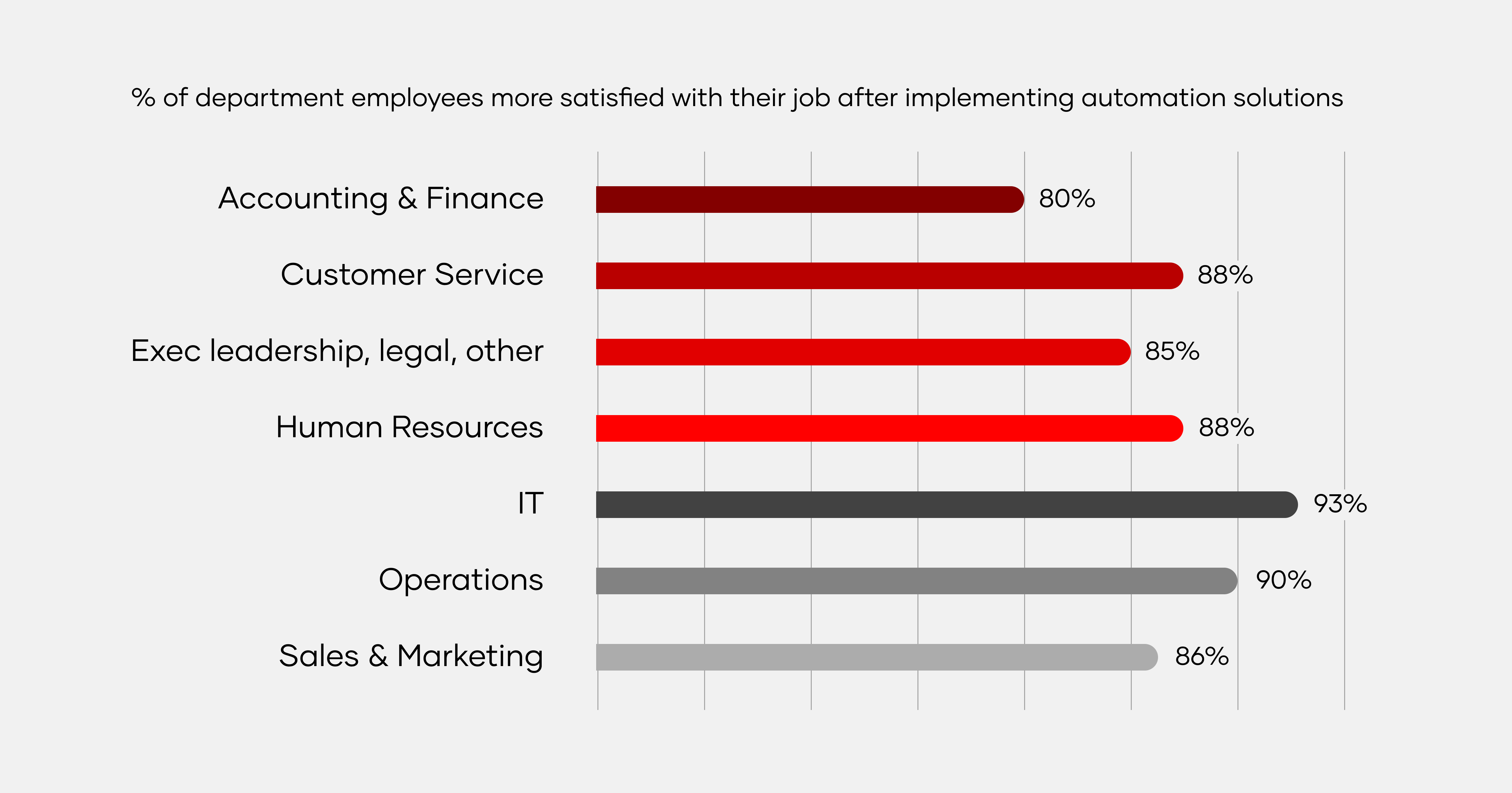
The primary reason cited was improved productivity. Over two-thirds of those using automation tools reported that these solutions helped them complete their tasks more quickly.
8. On average, businesses that have tested or implemented generative AI have reported a 6.7% increase in customer engagement and satisfaction.
Source: Capgemini Research Institute
The same research has shown that 82% of organizations plan to introduce AI agents within the next one to three years to handle tasks such as email creation, coding, and business analytics.
9. The top three areas where organizations apply digital process automation are operations (37%), onboarding (16%), and finance, accounting, and legal functions (14%).
Source: Forrester
Other common uses include compliance (12%), document management (8%), engineering and research and development (6%), case management (4%), and customer-facing activities (2%). Automation is also widely used in areas such as health, safety, and sustainability compliance, procurement, IT processes, and human resources.
10. North American companies are leading the way in AI chatbot adoption, accounting for 30.7% of market share, followed by organizations in the Asia-Pacific region at 28%, and European businesses at 25%.
Sources: Exploding Topics; Dashly.io
Adoption is higher among B2B than B2C firms (58% vs 42%). The most common B2B applications include lead generation, knowledge base automation, and internal support. The real estate sector stands out with the highest adoption rate at 28%, using chatbots to qualify leads and respond to property inquiries. These solutions have collectively saved an estimated $2.5 billion labor hours and around $11 billion dollars in annual customer service costs.
Business Process Automation ROI Stats
11. Robotic process automation (RPA) robots are far more cost-efficient than human employees.
Source: Institute for Robotic Process Automation
On average, RPA solutions cost about one-third of an offshore full-time worker and roughly one-fifth of an onshore employee.
12. Organizations that rely on automation for talent screening and hiring reduce their cost per hire by about 30%.
Source: Deloitte
Hiring automation also helps HR teams save time and focus on other, more strategic priorities.
13. Last year, 83% of sales teams using AI reported revenue growth, compared to 66% of those that did not.
Source: Marketsandmarkets
AI-driven sales tools have also increased deal closure rates by at least 30%. These tools automate high-volume, repetitive tasks such as nurturing leads, managing early sales funnel activities, sending follow-up messages, logging meeting notes, updating contact records, and generating performance reports.
14. Workflow automation reduces processing errors by as much as 70%.
Source: Gitnux.org
More than two-thirds of finance teams have reported higher accuracy and stronger compliance after adopting automated workflows. This also significantly reduces employee burnout.
15. In a recent survey, nearly all IT professionals (95%) reported higher business productivity after adopting process automation.
Source: Camunda
93% of IT respondents saw measurable business growth linked to automation, and 89% said their critical automated workflows now run smoothly across the organization.
16. Leaders in organizations already leveraging AI expect that by 2028, around 70% of their employees will rely on AI tools to automate or enhance parts of their work.
Source: UKG
Even among companies that haven’t yet adopted AI, executives anticipate that roughly 20% of their workforce will do the same within five years.
17. Nearly 60% of business process automation initiatives report positive ROI within 12 months, and about 73% of IT leaders say these solutions have reduced process time by half.
Sources: McKinsey & Company; VegamAI
Artificial intelligence and robotic process automation work best together. When integrated, they form intelligent automation systems capable of driving return on investment increases between 30% and 200% in the first year alone.
18. Business process automation helps project managers reclaim roughly 20% of their daily time.
Source: FlowForma
With repetitive tasks streamlined thanks to the efficiency gains automation brings, many PMs report handling twice as much work as before.
19. About 61% of companies using sales automation tools achieve a return on investment within six months.
Source: Marketsandmarkets
Additionally, 80% of sales teams report generating more leads after incorporating workflow automation into their CRM systems.
20. Business process automation can reduce operational errors by more than 70%.
Sources: Kissflow
On average, organizations report saving around $46,000 per year after adopting BPA solutions.
BPA Insights by Industry and Departments
21. Finance teams that adopted automated payment processing freed up more than 500 work hours each year.
Source: American Express Trendex Report: B2B Edition
This is equal to roughly 10 hours per week regained for higher-value tasks.
22. HR automations have surged by 599% over the recent years, and HR bots now play a role in nearly four out of ten hiring processes.
Source: SHRM Labs
This shift removes much of the repetitive administrative load and gives HR teams space to prioritize employee experience, engagement, and long-range workforce strategy.
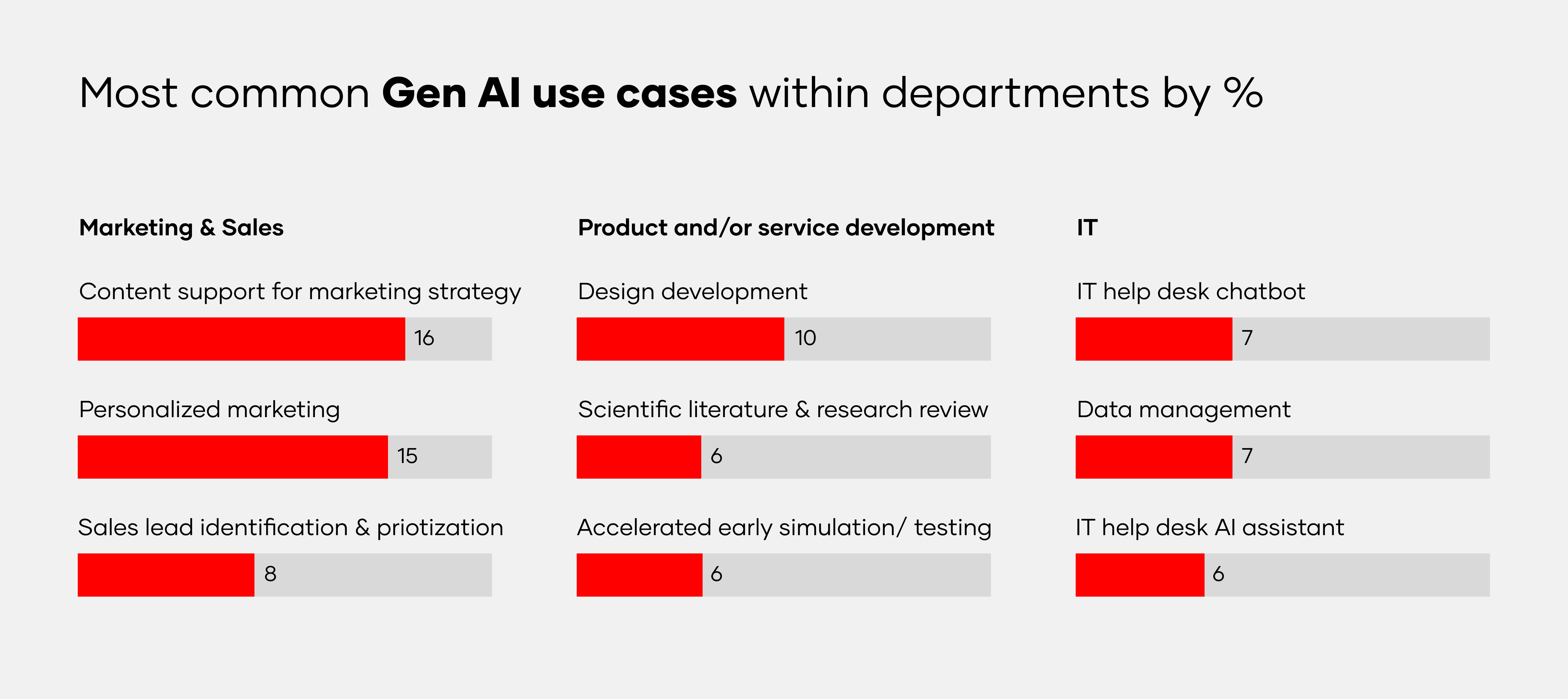
23. Sales and marketing teams lead the way in adopting generative AI and automation at 34%, followed by product and service development at 23% and IT at 17%.
The strongest industry adopters include logistics, retail and consumer goods, healthcare, automotive, and food and beverage manufacturing.
24. Marketing automation software increases qualified leads by 451%.
Source: Oracle
Research also shows it boosts overall lead volume by 80%, and more than three quarters of marketers report higher conversions after adopting it.
25. 40% to 65% of sales experts gain back at least an hour each week thanks to AI automation.
Source: Hubspot
In sales, the most common use of AI is cutting out manual work like data entry. Sales professionals also rely on ChatGPT, DALL-E, or Jasper for developing sales content and outreach emails.
26. A major multinational bank reported a 75% boost in threat detection speed after adopting an AI-powered detection system.
Source: International Journal for Multidisciplinary Research
False positives dropped by 99.9%, and investigation time fell by 60%.
27. 93% of e-commerce businesses view AI shopping agents as a competitive edge.
Sources: SellersCommerce, Precedence Research
The AI-powered e-commerce market has reached $8.65 billion in 2025. About 70 percent of consumers say they’re open to using AI for shopping tasks.
28. Healthcare systems now rely on automation at massive scale, carrying out more than 30 billion tasks a year across scheduling, claims work, and medication workflows.
Source: VegamAI
Automation continues to grow rapidly, contributing to about $250 billion in processing value.
29. By reducing manual workloads related to invoices, reports, or approvals, finance departments typically save around $46,000 per year.
Source: Stremeline
Core automation brings 20–30% cost relief, and intelligent automation that prevents errors can cut expenses by up to 70%.
30. Automated workflows and RPA tools improve phishing detection and response by as much as 70%.
Source: Ernst & Young
IT automation strengthens compliance by ensuring secure data practices and audit-ready business processes.
BPA Challenges
31. Fully automated workflows remain rare, with only 4% of companies achieving them.
Source: Formstack
While only 1% of BPA projects hit serious obstacles, small and mid-sized businesses see better outcomes overall - 65% success compared to 55% in larger organizations.
32. Weak change management is the top reason business automation efforts fall short, affecting 35% of projects.
Source: VegamAI
Other major reasons for BPA implementation failures include insufficient training (31%), choosing the wrong processes to automate (28%), and overly optimistic timelines (24%).
33. Forecasts show automation could displace as many as 83 million jobs in the second half of 2020s.
Source: World Economic Forum
Data entry roles are expected to take the biggest hit, with more than 7.5 million projected job losses.
34. Nearly half of companies foresee workforce cuts due to AI.
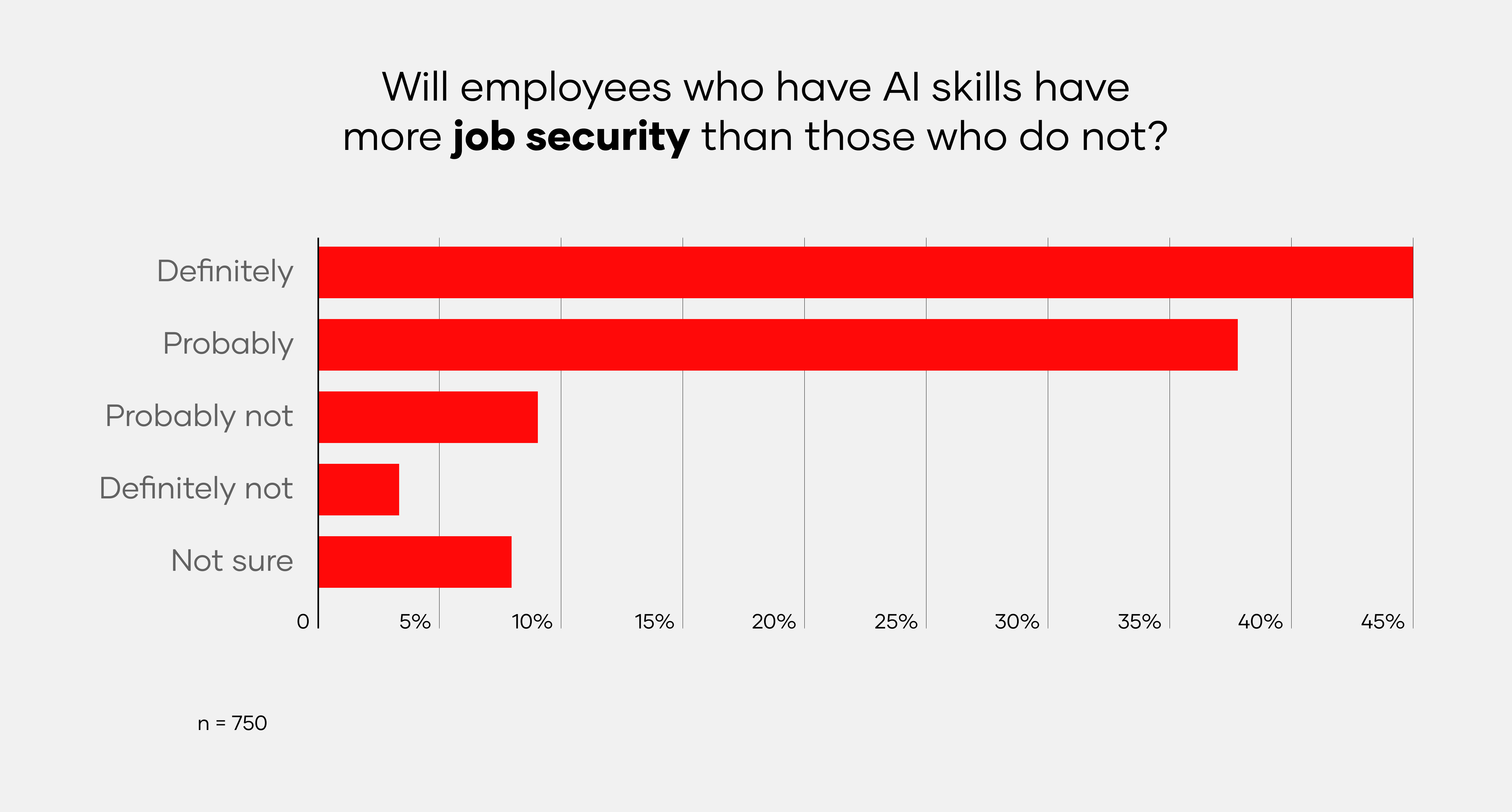
Twenty-one percent say layoffs are definite, 23% expect them, and 37% of AI adopters have already let people go.
35. More than 85% of Chief Financial Officers report difficulties in putting automation and new tech to work.
Sources: Forrester; PwC
Although most businesses anticipate efficiency gains from automation, fewer than 1 in 10 train their teams well enough to support it.
36. Roughly 70% of digital transformation efforts (automation included), fall short of their goals.
Source: BCG
Only 26% of automation initiatives deliver the ROI companies initially expected.
37. Up to 70% of Robotic Process Automation (RPA) efforts are consumed before implementation even begins.
Source: IBM
Key challenges include limited insight into business processes, lack of transparency to assess full RPA potential, difficulty measuring outcomes, and absence of a post-deployment maintenance plan.
38. Many large financial institutions continue to operate on legacy systems for essential daily functions, which creates major obstacles to adopting new technologies and automation.
Source: Software Improvement Group; IDC
Nearly all ATM transactions (95%) still rely on COBOL, a language with dwindling developer expertise. Failing to modernize could cost banks more than $57 billion by 2028, including 42% in lost payment revenue, while potential annual savings of 21% could remain untapped.
39. Most organizations (63%) must rely on a dedicated external partner to implement robotic process automation.
Source: Deloitte
This reflects a widespread shortage of in-house specialist skills.
40. The majority of executives feel their organizations lack the necessary AI and data science skills for automation.
Source: Strategic Market Research
Specifically, 90% of executives report gaps in basic process automation, 89% in advanced automation, and 75% in intelligent process automation.
BPA Market Insights and Projections for the Future
41. The business process automation market is expected to reach $52.2 billion by 2035, growing at a CAGR of 11.8%.
Source: Future Market Insights
To put it in perspective, the BPA industry was valued at $17.1 billion last year. The USA market is leading the way, projected to reach more than 80% of the BPA market share in ten years.
42. On-premise business process automation solutions remained the leading segment of the BPA market in 2025, making it more than 50% of the total market revenue.
Source: Future Market Insights
Major players in the BPA space include Microsoft, IBM, and Oracle.
43. Cloud-based BPA is projected to lead the global market in the years ahead, with estimates placing its value at USD 17,972.7 million by 2035.
Source: Future Market Insights
Compared to on-premise BPA systems that still dominate today, cloud BPA tools tend to be more flexible, affordable, and efficient.
44. When looking at technologies driving the intelligent process automation market, the machine learning segment represents the largest share and is expected to grow at a 22.6% CAGR by 2030.
Source: Grand View Research
Other major segments include natural language processing, robotic process automation, virtual agents, and computer vision.
45. Banking, Financial Services, and Insurance (BFSI) is the leading vertical in the global intelligent process automation market.
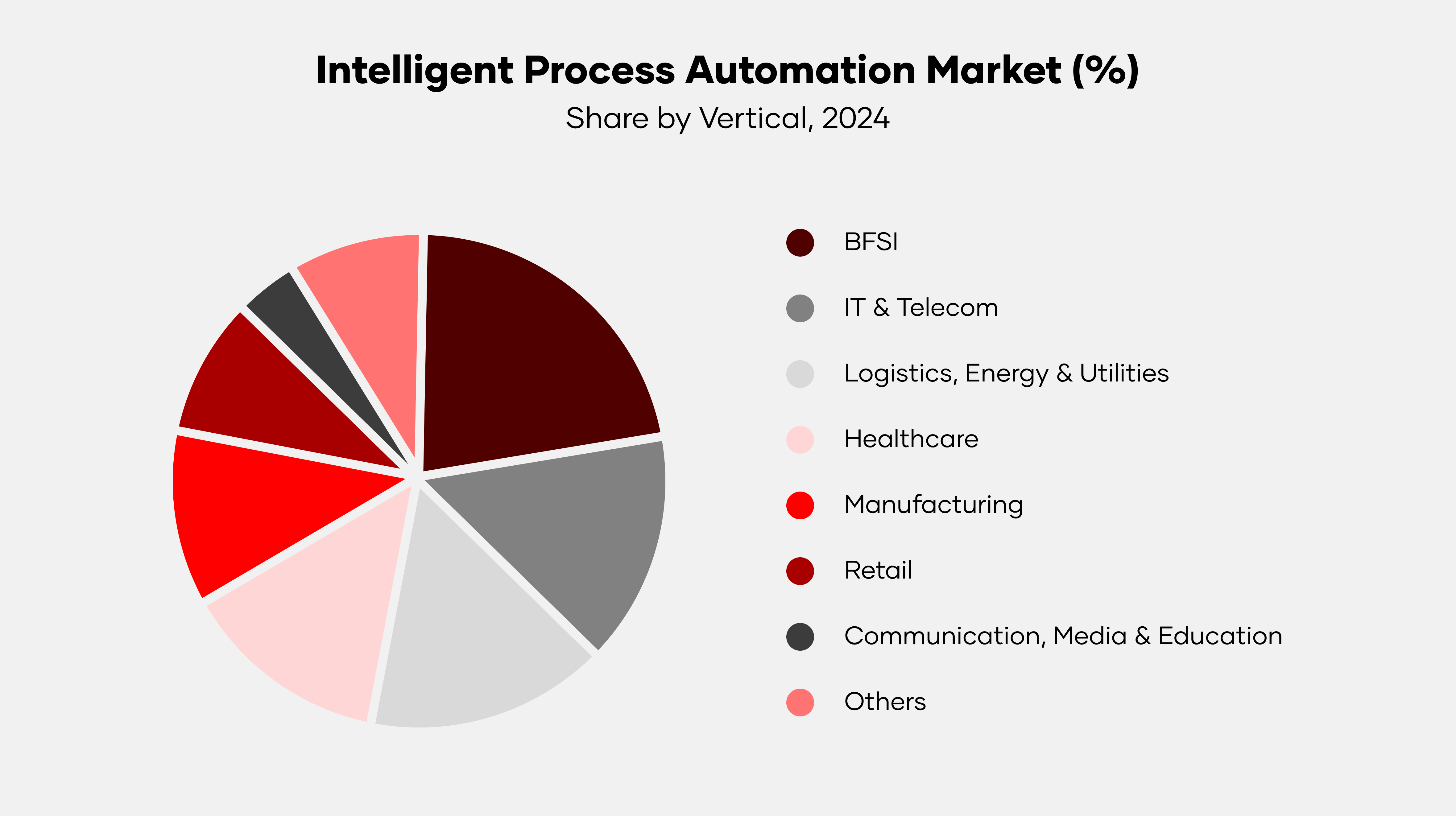
This growth is driven by the increasing volume of digital transaction data used to support decision-making, enhance operations, reduce costs, and improve customer experience.
Healthcare, however, is expected to see the fastest growth by 2030, as intelligent automation helps improve patient care, enable real-time disease analysis, and expand telehealth services.
Other important industry verticals in the market include IT and telecom, logistics, manufacturing, retail, and communication, media, and education.
46. The hyperautomation market is projected to reach USD 31.95 billion by 2029, with a CAGR of 19.80%.
Sources: Mordor Intelligence; EvinceDev
Compared to BPA, which is limited to repetitive tasks and may require human intervention, hyperautomation spans end-to-end processes across all business functions, reduces the need for human involvement, and is built for greater scalability and stronger system integration. In fact, it has the potential to create a digital twin of the organization.
Examples of hyperautomation use cases in large companies include: Unilever integrating it into their hiring processes, Nike using it to improve customer experiences and drive product innovation, and Maersk applying it within their logistics and supply chain operations.
2am.tech’s mission is to reinvent businesses through software solutions. We strongly believe that automation is a must for modern organizations. If you’re looking to simplify operations, eliminate inefficiencies, empower your teams, and build a future-proof business, contact us, and let’s innovate together.


.jpg)